


Treatments < Urology < Pediatric urology
Pediatric Urology Care for Children in Ahilyanagar
Children can experience urinary and genital health conditions that require specialized medical evaluation. Pediatric urology focuses on diagnosing and managing conditions affecting the urinary tract and reproductive organs in infants, children, and adolescents.
At Satalkar Lotus Hospital, families can enquire about pediatric urology consultations in Ahmednagar for concerns such as undescended testicles, hypospadias, urinary tract infections, bedwetting, and other urinary or genital conditions. Dr. Harshwardhan Tanwar is associated with the hospital’s urology services. The appropriate specialist and treatment plan depend on the child’s age, symptoms, and medical condition.
If you are searching for pediatric urology in Ahmednagar, understanding the symptoms, available evaluations, and possible treatment options can help you make informed decisions about your child’s healthcare.

PEDIATRIC UROLOGY
What Is Pediatric Urology?
Pediatric urology is a medical and surgical specialty concerned with urinary tract and genital conditions in children. It covers problems involving the kidneys, ureters, bladder, urethra, and male genital organs.
Children’s urinary and genital conditions can differ from those seen in adults. Some are present at birth, while others develop during childhood or adolescence. Depending on the condition, management may include observation, medication, diagnostic tests, or surgery.
A consultation with an appropriately qualified specialist helps determine the cause of the problem and whether treatment is needed.
Pediatric Urology Conditions
Undescended Testicle
An undescended testicle is a condition in which one or both testicles have not moved into the scrotum before birth. It is commonly identified during a newborn examination or early childhood assessment.
Possible signs and concerns:
- One or both testicles cannot be felt in the scrotum.
- The scrotum may appear less developed on one side.
- The condition is noticed during a routine physical examination.
Treatment depends on the child’s age and clinical findings. Surgery, known as orchiopexy, is commonly recommended when a testicle remains undescended. Timely assessment is important because the condition can affect future fertility and increase certain long-term risks.
PEDIATRIC UROLOGY
WHAT IS UROGYNECOLOGY?
Urogynecologists are doctors who receive special training to diagnose and treat women with these disorders. Some of the common problems treated by a urogynecologist include urinary incontinence or leakage, pelvic organ prolapse (dropping of the vagina, uterus, bladder, and rectum), and an overactive bladder. Other conditions include fecal incontinence, vaginal atrophy, recurrent urinary tract infections, hormone replacement, interstitial cystitis, fistulas, and neurological dysfunction of the bladder and pelvic floor.
Urogynecology can also address female sexual dysfunction and painful intercourse. A urogynecologist completes medical school and a residency in obstetrics and gynecology, or urology. These physicians are specialists with additional years of fellowship training and certification in female pelvic medicine and reconstructive surgery. The training provides expertise in the evaluation, diagnosis, and treatment of conditions that affect the muscles and connective tissue of the female pelvic organs. For better treatment, see the Best Female Urogynecologist in Nashik. Meet Dr. Sudarshan Daga, Ahilyanagar
Hypospadias
Hypospadias is a condition present at birth in which the opening of the urethra is located on the underside of the penis rather than at its tip. The degree of variation differs from child to child.
Possible signs include:
- An opening in an unusual position.
- A downward curve of the penis.
- A urinary stream that does not pass straight forward.
A pediatric urology assessment helps establish the severity and discuss whether surgery is appropriate. Treatment decisions depend on the child’s individual anatomy and medical needs.
Varicocele in Adolescents
A varicocele is an enlargement of veins within the scrotum. It often becomes noticeable during adolescence and may occur without symptoms.
Some adolescents may experience scrotal discomfort, a feeling of heaviness, or a difference in testicular size. A clinical examination helps determine whether further investigation or monitoring is needed.
Treatment is not necessary in every case. Depending on symptoms, testicular development, and examination findings, the doctor may recommend observation or discuss a procedure.
Vesicoureteral Reflux
Vesicoureteral reflux occurs when urine flows backward from the bladder toward one or both ureters and sometimes the kidneys. It may be identified during the evaluation of recurrent urinary tract infections or certain urinary tract abnormalities.
Possible concerns include:
- Repeated urinary tract infections.
- Fever associated with a urinary infection.
- Findings on imaging that suggest an abnormal flow of urine.
Management depends on the severity of reflux, the child’s age, kidney health, and history of infections. Options may include monitoring, preventive measures, medication in selected cases, or surgery when indicated.
Bedwetting in Children
Bedwetting refers to involuntary urination during sleep in a child who is at an age when nighttime bladder control is generally expected. It is common in childhood and is not usually the child’s fault.
Possible contributing factors include delayed development of nighttime bladder control, constipation, family history, sleep-related factors, or certain medical conditions.
A medical assessment may be useful when bedwetting persists, begins again after a period of dryness, or occurs with daytime urinary symptoms. Treatment can include practical routines, bladder-management strategies, bedwetting alarms, or medication when appropriate.
Urinary Tract Infections in Children
A urinary tract infection (UTI) occurs when bacteria infect part of the urinary system. Symptoms vary according to the child’s age.
Possible symptoms include:
- Fever without an obvious cause.
- Pain or burning during urination.
- Frequent or urgent urination.
- Abdominal or back pain.
- Vomiting, irritability, or poor feeding in younger children.
A urine test and, when appropriate, a urine culture can help identify an infection. Treatment generally involves an appropriate antibiotic prescribed by a healthcare professional. Recurrent infections may require further assessment to look for an underlying urinary tract problem.
A child with fever and suspected UTI should be assessed promptly, particularly if the child is very young or appears seriously unwell.
Symptoms That May Need a Pediatric Urology Consultation
Consider seeking medical advice if your child has:
- Recurrent urinary tract infections.
- Difficulty passing urine or an abnormal urinary stream.
- Persistent bedwetting with other urinary symptoms.
- A testicle that cannot be felt in the scrotum.
- An unusual position of the urethral opening.
- Scrotal swelling, discomfort, or a difference in testicular size.
- A known urinary tract abnormality identified before or after birth.
Seek urgent medical care for sudden, severe testicular pain or swelling, inability to pass urine, or a child who appears seriously unwell. Sudden testicular pain can be a medical emergency and should not wait for a routine appointment.
How Are Pediatric Urology Conditions Diagnosed?
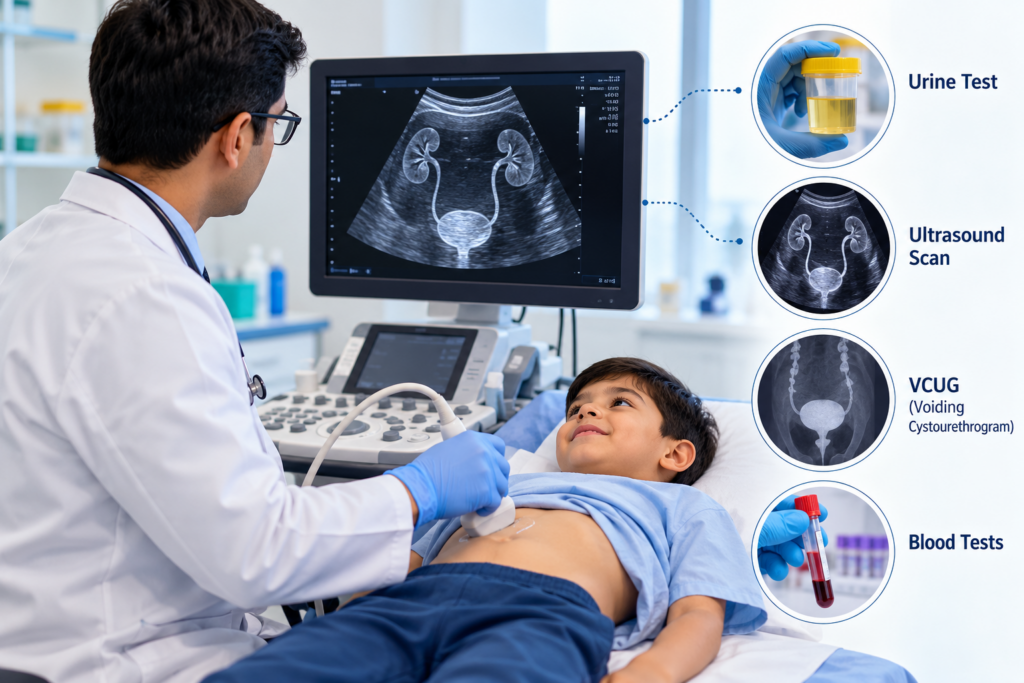
The evaluation depends on the child’s symptoms, age, medical history, and physical examination. The doctor may recommend one or more of the following when clinically appropriate:
Medical History and Physical Examination
The doctor may ask about urinary habits, previous infections, symptoms, birth history, and any earlier investigations. A physical examination helps identify findings that may require further evaluation.
Urine Tests
Urinalysis and urine culture may be used when a urinary tract infection or another urinary problem is suspected.
Ultrasound and Other Imaging
Ultrasound may help assess the kidneys, bladder, or other relevant structures. Additional imaging or tests are recommended only when needed for the suspected condition.
Further Investigations
Some children may require specialized tests to assess bladder function, urine flow, or urinary tract anatomy. The choice of investigation depends on the clinical findings.
Pediatric Urology Treatment Options
There is no single treatment for all pediatric urology conditions. Management is selected according to the diagnosis, severity, age of the child, and potential long-term effects.
Depending on the condition, treatment may involve:
- Observation and follow-up: For selected conditions that may improve or remain stable.
- Medication: For certain infections or other conditions where medication is appropriate.
- Bladder and urinary habits: Practical guidance for selected children with bedwetting or urinary symptoms.
- Further diagnostic assessment: To understand recurrent symptoms or identify an underlying abnormality.
- Surgical treatment: For conditions such as persistent undescended testicles or selected cases of hypospadias and vesicoureteral reflux.
Parents should discuss the expected benefits, possible risks, alternatives, and follow-up requirements with the treating specialist before making treatment decisions.
Pediatric Urology Care at Satalkar Lotus Hospital, Ahmednagar
When a child has a urinary or genital health concern, parents need clear information about the next steps. A timely assessment can help identify the cause of symptoms and determine whether observation, medical management, further tests, or surgery may be appropriate.
Satalkar Lotus Hospital provides urology services associated with Dr. Harshwardhan Tanwar. Contact the hospital to confirm whether pediatric urology consultations are currently available, the doctor’s experience with the specific condition, and whether referral to a pediatric urologist is required.
If you are looking for pediatric urology treatment in Ahmednagar, contact the hospital to discuss your child’s symptoms and arrange an appropriate consultation.
Book a consultation: Contact Satalkar Lotus Hospital through its official appointment or contact page to confirm availability and consultation timings.
Frequently Asked Questions
Pediatric urologists evaluate and manage urinary tract and genital conditions in children. These may include undescended testicles, hypospadias, vesicoureteral reflux, urinary tract abnormalities, and certain bladder or urination problems.
Consider a consultation for recurrent urinary infections, difficulty urinating, an undescended testicle, an unusual urethral opening, persistent urinary symptoms, or a known urinary tract abnormality. Sudden severe testicular pain requires emergency assessment.
Endourologists use specialized techniques to assess and treat selected conditions affecting the urinary tract. These may include certain kidney stones and urinary tract problems requiring endoscopic procedures. Treatment suitability depends on the diagnosis and the clinician’s assessment.
Yes. When a testicle remains undescended, surgery called orchiopexy is commonly recommended. A doctor should assess the child and advise on the appropriate timing.
A healthcare professional may recommend urine testing and prescribe an appropriate antibiotic when a bacterial UTI is diagnosed or strongly suspected. Recurrent infections may require further investigation.
No. Some varicoceles can be monitored. The decision depends on symptoms, testicular development, examination findings, and other clinical factors.
Contact Satalkar Lotus Hospital to confirm whether pediatric urology consultations are available, which specialist is appropriate for your child’s condition, and how to book an appointment.
